Berber Tours to Morocco are authentic way to
Discover a Berber Village, visit ancient kasbahs and camel trek in the Sahara Desert.
Discover a Berber Village is a Southern Morocco Cultural Tour that is an EXCLUSIVE
Travel Exploration Morocco.
Discover a Berber Village is a historical journey where Moroccan travelers can have an up close and authentic experience in a Moroccan, Berber Village while visiting the Ouarzazate and
Zagora regions of Morocco. When traveling to Morocco, a Morocco vacation is not complete without visiting Morocco’s indigenous people and discovering its Berber Villages. A Berber Tour to Morocco is the most important Moroccan voyage for those who are interested in Morocco’s history and old world traditions.

Visiting Morocco on a
Berber Tour, offers Moroccan travelers the opportunity to spend the day and an over night stay with a Berber family in Ait Ouzzine, (translated from Berber as “the nice village”) near the small city of N’kob within the Zagora region. Ait Ouzzine is a Berber village that tucked beneath the Middle Atlas Mountains within the Draa Valley region. Visiting the
Berber Village of Ait Ouzzine on a Berber Tour guarantees a unique Morocco Travel adventure. A visit to the Berber village, Ait Ouzzine includes partaking in a cooking lesson of how to make traditional bread and a Moroccan tajine, exploring the village’s Kasbahs by foot, strolling the green fields and seeing first hand, how the traditional Berbers live among their live stock and at peace within their natural surroundings.

During the
Berber Tour in Ait Ouzzine, a traditional Berber family will serve lunch and host you as a Moroccan traveler with top quality and genteel service. The menu for your Berber Tour in a Berber village for lunch will include a traditional meal of Moroccan couscous, followed a Moroccan tajine and fresh local fruits for desert.
After lunch, part of the
Berber Tour includes having your hands and feet adorned with
henna by a local village artist and experiencing the tradition of Berber perfume. The Berber Tour does not end here. After experiencing the unique making and enjoyment of Berber perfume, Moroccan travelers will be able to spend the night with a Berber family in their traditional family Kasbah.
The Berbers are the original inhabitants of Morocco. It is said that the origin of the Berbers is Afro-Asiatic. The Berbers refer to themselves as Imazighen, meaning “free people.” The Berber population in Morocco fled to the mountain regions when the Arabs invaded the Maghreb in the seventh century. The Berbers witnessed several invaders come and go such as the Carthaginians, Romans, Vandals, Byzantines – while they remained secure in the mountains and the depths of the desert.
When the Arabs invaded in the seventh century, the Berbers quickly adopted Islam. Today, a majority of North Africans are of mixed Amazigh and Arab ancestry yet consider themselves Arabs. Of the minority that identifies as Amazigh, the largest group lives in Morocco, making up about a third of the country’s 32 million people.
Since the Arabs conquered Morocco, the Berbers in the Middle Atlas Mountains and other regions of Morocco have maintained ancient traditions and preserved a unique, semi-nomadic lifestyle that is authentic Moroccan. As converts to Islam, the Berbers kept their original cultural and religious traditions in tact while accepting those imposed by the Arab population. Today Berbers practice both their own cultural traditions and observe Islamic religious and cultural traditions as well.

As one of the most modern Muslim country’s in the world where Arabs, Jews and Christians have lived side by side in relative peace for centuries, Morocco boasts the largest Berber population who maintain their oral, agricultural and ancient traditions through the expression of Berber music, Berber culture, Berber food and Berber dance. The
Timitar Festival in
Agadir which is held annually in July is a celebration of both Berber Music & other styles of Moroccan music. Another tradition that is recognized among the Berber population is the
Imilchil Marriage Festival which is an authentic marriage ceremonial mousseum whereby Berber men gather to choose their brides. The I
milchil Marriage festival takes place in the Middle Atlas Mountain regions in September annually and is also referred to as the “September Marriage Festival.” The Berbers also carry on this tradition of peace that Morocco upholds through their gracious hospitality, love and genuine kindness for each other as a community and foreigners, Moroccan travelers who visit them.

While Morocco’s population is approximately 85% Berber, the main language spoken and taught in schools is Arabic with the recent addition of French as a second language and in some cities English is offered as a third language. Since the reign of King Mohamed VI, who is often referred to as “the peoples King,” recognition and respect for Berber culture, their traditions and the Berber language has heightened significantly. Mohamed VI is seen as one of Morocco’s most progressive King’s who has modernized Morocco’s Imperial Cities and Morocco’s countryside. Mohamed VI of has lead the Kingdom of Morocco into further development on the world stage and is a modest King who is deeply loved and respected by the entire population of Morocco, as well as international leaders, world wide.
The Berbers are still considered a minority in Morocco however this is rapidly changing. The Berber language is now being taught in schools and there 2010 marked the launch of a Berber “Tamazight” television station dedicated to broadcasting in Tamazight, the language of the country’s Amazigh, or Berber, people.
Officially launched the first week in January 2010 by Morocco’s state-owned TV and Radio Company, “Tamazight Channel is the latest effort to boost Amazigh culture and language by a government keen to avoid political clashes along ethno-linguistic lines,” claims The National. Tamazight Channel’s director, Mohamed Mamad, is adamant that his team “serves to consolidate the unity of the country”. While 30 percent of the Tamazight Channel’s programs will be in Arabic, the bulk of its 70 percent will air – with Arabic subtitles – in Tamazight.
There are three main Berber dialects spoken in Morocco: Tamazight- Middle Atlas Mountain region, Tarafit in Northern Morocco and Tashelhit in the Souss- Agadir Region. When traveling on a Berber Tour to the Ouarzazate and Zagora region it is best to use a Ouarzazate Travel Agency and make sure that your driver speaks fluent Berber which will enable you as a Moroccan traveler to have the best travel experience on your Berber Village Discovery Tour. BERBER TOURS TO MOROCCO: 7 Day Berber Village Tour
DAY 1: OUARZAZATE
►Arrive in
Ouarzazate, a French developed area that became a garrison town and is now the administrative centre of the Zagora region. Relax at your hotel and visit the souks. Enjoy dinner at the Berber Palace Hotel at their luxurious Moroccan Palace restaurant.
►
“See
Ouarzazate and die” are feelings often expressed by Moroccans with regards to this magical city that is the door to the
Sahara desert. Located just four hours from Marrakech, Ouarzazate is the main Berber city in the south known for its spectacular sunsets and dramatic mountain and desert scenery. Surrounded by breathtaking valley, Ouarzazate was once crossing point for African traders seeking to reach northern cities in
Morocco and Europe.
DAY 2: OUARZAZATE – ATLAS FILM STUDIO – AIT BENHADDOU – OASIS OF FINT
►Fill up on a savory breakfast of baguette, fresh fruit, jams and a café cassis (Moroccan cappuccino) at a local pâtisserie and then begin your one-day excursion to
Atlas Film Studios, Aït Benhaddou and the Oasis of Fint.
►Start your morning by touring the Atlas Film Studios. David Lean filmed Lawrence of Arabia at The Atlas Film Studios in the early 1960’s. Since then many famous directors have followed in his footsteps to exploit the magnificent scenery. International blockbusters shot here in recent years include: the French version ofCleopatra, Bertolucci’s Sheltering Sky, Scorsese’s Kundun, Gillies MacKannon’sHideous Kinky,Ridley Scott’s Gladiator, Black Hawke Down, Oliver Stone’s Alexander The Great, Ridley Scott’s Kingdom of Heaven, and Penelope Cruz’s Sahara.
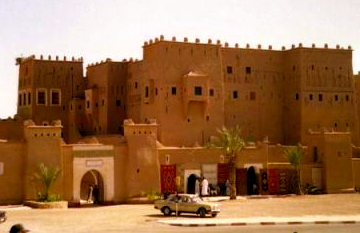
►After visiting the Atlas Film Studio, we will take the road by pise to the picturesque village of Aït Benhaddou located 32 km from Ouarzazate. Aït Benhaddou is situated in Souss-Massa-Draa on a hill along the Ouarzazate River. Lawrence of Arabia was filmed here and Orson Welles used it as a location for Sodome and Gomorrah; and for Jesus of Nazareth the whole lower part of the village was rebuilt. In recent years more controlled restoration has been carried out under UNESCO auspices. Aït Benhaddou is one of many locations in this region used for shooting Hollywood films.
►Your guide will lead you on a private tour through this Berber village of towered and crenulated kasbahs that once guarded the lucrative caravan route through the Atlas Mountains. Explore the kasbahs by foot with the option to ride a donkey across a river.
►Aït Benhaddou was once a significant stop for traders carrying gold, salt and slaves along the famous Southern Caravan route moving through the Sahara. Only six miles away, is the village of Tamdaght, dominated by the canyon walls of a Glaoui Kasbah. The Kasbah is famous and you will find its towers inhabited by storks. Walk outside the Kasbah’s lush terraced gardens and witness the same desert scenery that used inGladiator and Alexander the Great.
►For lunch, relax on a terrace with clear views of Aït Benhaddouand enjoy a traditional Moroccan meal of mfouar (steamed wheat), Takila (a Berber tajine), couscous and fruit. After lunch, browse the village shops then climb back in the comfortable air-conditioned/heated 4×4 and head to the village of Tamadaght.
►After lunch, we will depart Aït Benhaddou and take the pise (windy road) towards the Oasis of Fint passing the “Plateau de pierres”. On this road you will find a shining Oasis of palms. Visit this
Oasis of Fint that hovers under the Atlas Mountains. Journey on a one-hour walk inside the Oasis where you will have a cup of tea with the headmaster’s family Azziz Ouaziz and tour the surrounding area where date palm oases and dramatic desert scenery are king.
►After visiting the Oasis of Fint we will take the road to Kasbah Tifoultoute which stands majestically on the banks of Oued Tifoultoute. From a distance this old Kasbah is impressive with its castle-like architecture. In the 1960’s the Kasbah was converted into a hotel for the cast of Lawrence of Arabia. Tour the Kasbah and have lunch at its restaurant which is known for delicious mint and herb teas. See panoramic views from the rooftop.
DAY 3: OUARZAZATE– SKOURA – EL KELLAT DES MGOUNA– BOULMANE DADES
►After breakfast at your hotel, we will depart Ouarzazate, taking the “Road of One Thousand Kasbahs” and passing by the large lake of Ouarzazate to drive to Skoura.
►Skoura is a fertile oasis lined with immense palm groves that provide great views of the Atlas Mountains alongside deserted landscapes. It is renowned for the cultivation of roses. The palm groves were laid out in the 12th century by the Almohad sultan Yacoub el-Mansour and named after its original inhabitants, the Berbers of the Haskourene tribe. The most beautiful Kasbahs in southern Morocco can be found here. Many of them are still partially inhabited.
►The small, sleepy town of
Skoura has a big market Souk every Monday and a small group of administrative buildings. Most impressive in Skoura are the many Kasbahs that ripple through its dry rocky oasis. Skoura is referred to as the “
Valley of OneThousand Kasbahs.” You will visit the 17th Century old Ben Morro Kasbah, which has been converted into a guesthouse and see the most imposing of the Kasbahs in this area, Amerhidil Kasbah. This fortified residence once belonged to the most powerful family responsible for protecting the village and its lands called the Glaoui. Today it is owned by the Sheikh of Amerhidil.
►We will visit the Kasbahs of Aït Abou, built in the 1800’s and the oldest Kasbah in the palm grove, is six stories and walls 25 m high. Its outside buildings have been turned into a garden filled with pomegranate,apple, pear, fig, quince and olive trees that provide the necessary shading for growing crops.
►Pass by Skoura, drive north heading towards the Amagoun Mountains and
Berber villages standing among splendid landscapes and the Valley of Roses.
►Your driver will stop for you to view the Capp et Florale distillation factories laid out in
El Kelaa Des Mgouna, a small Kasbah town that manufactures the entire nation’s products of eau de rose. The rose water and other products such as hand and body soaps, oil, crème perfume and dried flowers are for sale and also popular among Moroccans. The factories produce 3000-4000 petals a year. With ten tons of petals required to produce a few liters of precious oil, the harvest is understandably a labor of love and the culminating Festivities of the annual Rose Festival are all the livelier for it.
►Once in the Valley of Roses, you will immediately notice that the fresh mountain air in this part of southern Morocco has a hint of fresh roses which makes it a particular nice place to go for walks, short hikes and a long drive through the Hdida Valley to the plateau of Imi-n-Louh. Your driver will stop along the way so you can meet the friendly locals, many who are nomads and spend their winters in the nearby caves. There are many photo opportunities in this
Dadès Valley town of ancient kasbahs.
►For lunch, we will relax on a petite terrace at Kasbah Itran, a local auberge that overlooks two large abandoned crenulated Jewish Kasbahs and a river.
►After lunch drive to the
Boulmane Dades and spend the night in a local hotel amidst the gorge.
DAY 4: TODRA GORGE – N’KOB
►After a hearty Moroccan breakfast head for the adventure of a lifetime to experience the
Todra Gorge in the High Atlas Mountains. The drive is scenic as with the new roads built, you will drive past the hotels at the mouth of the Gorge and up to the villages of
Aït Hani,
Tamtatouchte, and
Imilchil. The Gorge extends from the village of Tamtatoucheto Tinerhir.
►The Todra, with cliffs rising dramatically up to 300m on each side of a narrow corridor, make up some of the most impressive cliffs and are by far, the highest in Morocco. The Todra Gorge is a spectacle with its gigantic rock walls changing color to create magical effects with the sunlight. In the morning, when the sun permeates through the bottom of the gorge, the rock changes from pink rose to deep ochre gradually throughout the rest of the day.
►A day at the Todra offers the option of extreme climbing or light hiking and sightseeing. A more strenuous hike would involve a three hour loop used by donkeys and mules heading north of the main gorge to Tizgui, home of palmeries and ancient kasbahs. For a lighter hike, try the Petit Gorge entering at the mouth of the gorge. The mouth is an enclosed section with overhanging cliffs and is the most dramatic scenery in the gorge. Climbing in the Todra Gorge is an unforgettable experience
►It is possible to have lunch inside the Todra Gorge or at one of the restaurants beneath the overhanging cliffs with a panoramic view. After lunch you can continue by road or hike by foot, or horseback to explore the surrounding area and its Berber villages. Sometimes you can find the Nomad women with children from the Atlas Mountains visiting the Gorge to carry water by donkey to their village. Your driver will give you the option to visit the picturesque village of Tamtattouchte, whose red toned earth houses are located at the other end of the gorge.
►End your day with a drive to the village of N’kob for an overnight stay at a beautiful Maison de Charme in a riad style, built with the materials of the Moroccan tradition such as taddelakt and zellig. Ksar Jenna has wide open spaces, 7 rooms with every comfort, with large bathrooms and large common spaces, plunged in an oasis of quiet, in the heart of a luxuriant garden, with lots of palm trees, bougainvilleas, rose bushes, jasmines.
DAY 5: N’KOB– DISCOVER THE BERBER VILLAGE OF AIT OUZZINE
►Enjoy breakfast at your Riad and then walk to the village of Ait Ouzzine for a traditional Berber experience.
►Just 5 kilometers after N’kob is Aït Ouzzine (the nice village). Aït Ouzzine is a Berber village inhabited by over 300 families who live in beautifully painted crenulated kasbahs, with their own henna fields, water wells, livestock and gardens. This peaceful village is tucked away along an impressive desert route connecting the Draa Valley (Tansikht) and Rissani.
►Meet a local Berber family, partake in a cooking lesson of how to make traditional bread and a tajine. Then explore and tour the village by foot. Walk in the green fields and see how the traditional Berbers live with their gardens of herbs, live stock, and henna plants.
►Lunch will be served to you in Aït Ouzzine by a traditional Berber family. The menu will include a traditional meal of fresh baked bread with spices and a chicken and vegetable tajine and fresh local fruits for desert. After lunch, you can have your hands and feet painted with henna by a local village artist and relax. End the afternoon with mint tea and almonds. Then rest at your hotel before having a traditional dinner with the Berber family of couscous and sheep’s stomach that is grilled by fire. This is similar to an American barbecue. After dinner spend the night with a Berber, Moroccan family in their traditional Kasbah.
DAY 6: N’KOB – ZAGORA – OUARZAZATE
►Fill up on a savory breakfast of baguette, fresh fruit, jams and a café cassis (Moroccan cappuccino) at a local pâtisserie and then begin your excursion to Zagora.
Zagora is a Saharan desert town in the southern Drâa Valley.
►Zagora is favored by travelers for its desert dunes, palms, 45 varieties of dates and its Hollywood sunset mountain backdrops. Take the road by pise (windy road) to discover the land where caravans once transported sugar, tea, dates and other dry goods to Ouarzazate.
►Walk the palmery and hamlet set amid lemon, almond and olive trees, and gardens of the village of Amazrou. Visit the former Mellah (Jewish quarter), where a mosque now stands. Amazrou is inhabited by Arabs, Haratines and Berbers who continue the Jewish tradition of silver making.
►Later enjoy a camel excursion across the Dunes of Tinfo and visit the old Kasbah Ait Lkaid in the village of Tamegroute. At the end of the main road you will find the famous road sign to Timbuktu that reads “52 jours” – 52 hours by camel.
►Enjoy lunch at a local kasbah hotel restaurant in the town of Zagora. The Dunes of Tinfo (as well as many other sand dunes in Morocco) are famous for their healing qualities for rheumatoid arthritis. Ask your guide to bury you in the sand from head to toe for this a 20 minute spa-like experience.
►Upon return to Ouarzazate we will take the road to visit Zagora’s unique, beautifully glazed forest green pottery at the local cooperative in the desert town of Tamagroute and pass by the Koranic library.
►Take the road back to Ouarzazate, check in at your hotel, have dinner and relax for the evening.
DAY 7: OUARZAZATE
►Rise early for your departure to the airport in Ouarzazate. This ends your Berber Tour and Morocco Travel experience with Travel Exploration, a Ouarzazate Travel Agency.
BERBER TOURS TO MOROCCO: A One Day Excursion to a Berber Village From Ouarzazate
►Enjoy breakfast at your Riad in
Ouarzazate. Then take the road through the Draa Valley to Discover the Berber Village Ait Ouzzine. Arrive in Ait Ouzzine in early afternoon.
►Just 5 kilometers after N’kob is Aït Ouzzine (the nice village). Aït Ouzzine is a Berber village inhabited by over 300 families who live in beautifully painted crenulated kasbahs, with their own henna fields, water wells, livestock and gardens. This peaceful village is tucked away along an impressive desert route connecting the Draa Valley (Tansikht) and Rissani.
►Meet a local Berber family, partake in a cooking lesson of how to make traditional bread and a tajine. Then explore and tour the village by foot. Walk in the green fields and see how the traditional Berbers live with their gardens of herbs, live stock, and henna plants.
►Lunch will be served to you in Aït Ouzzine by a traditional Berber family. The menu will include a traditional meal of fresh baked bread with spices and a chicken and vegetable tajine and fresh local fruits for desert. After lunch, you can have your hands and feet painted with henna by a local village artist and relax. End the afternoon with mint tea and almonds. Then rest at your hotel before having a traditional dinner with the Berber family of couscous and sheep’s stomach that is grilled by fire. This is similar to an American barbecue. After dinner spend the night with a Berber, Moroccan family in their traditional Kasbah.
►After visiting a Berber Village on a one-day excursion, Berber Tour from
Ouarzazate, take the road and return to Ouarzazate. En route to your return, stop to visit the Berber Village &
Ait Benhaddou Kasbah. Explore Ait Benhaddou by foot and then have tea in a lovely auberge that overlooks
Ait Benhaddou. End the day watching the sunset in Ait Benhaddou and then return to your Riad in Ouarzazate.
For more information about Travel and Tours to Morocco plus highlights on Moroccan culture visit
Morocco’s Imperial Cities,
Seaside Resorts,
Sahara Desert,
Berber villages,
A Taste of Morocco,
Magical Kasbahs, Ruins & Waterfalls,
Absolute Morocco, The Best of
Marrakech,
Fes, and
Ouarzazate.
Travel Exploration specializes in
Morocco Travel. We provide Tours and travel opportunities to Morocco for the independent traveler and tailor-made tours for families and groups with a distinctly unique flavor. From Morocco’s Seven Imperial Cities, to the Magical Sahara Travel Exploration offers a captivating experience that will inspire you. At Travel Exploration we guarantee that you will discover the best of Morocco! Call Travel Exploration at
1 (800) 787-8806 or 1 (917)703-2078 and let’s book a tour to Morocco for you today.
Berber Tours To Morocco, Berber Tours, Travel to Morocco For a Berber Tour, One-day Berber Tour Excursion, Excursion to Berber Village, Discover Berber Villages, Berber Villages, Berber Kasbahs, Camel Trek, Sahara Desert, Ait Benhaddou Berber Village, Draa Valley, Zagora Dunes of Tinfo, Ait Benhaddou Kasbah, Ait Benhaddou, Ouarzazate Travel